Heritage, Identity or Strategy?
“We are brewers”
Last Friday I spent a morning at the Belgian family-owned brewery Duvel, and every wall in the building told their deeply rooted heritage story. Founders' portraits, old recipes, a century of beer labels.
Yet, somewhere between all the kettles and the archives, the owner and CEO stated that the family does not want to do anything else but beer. After all, they are brewers. Passionate craftsmen. That's the whole business identity.
I've thought about that sentence ever since.
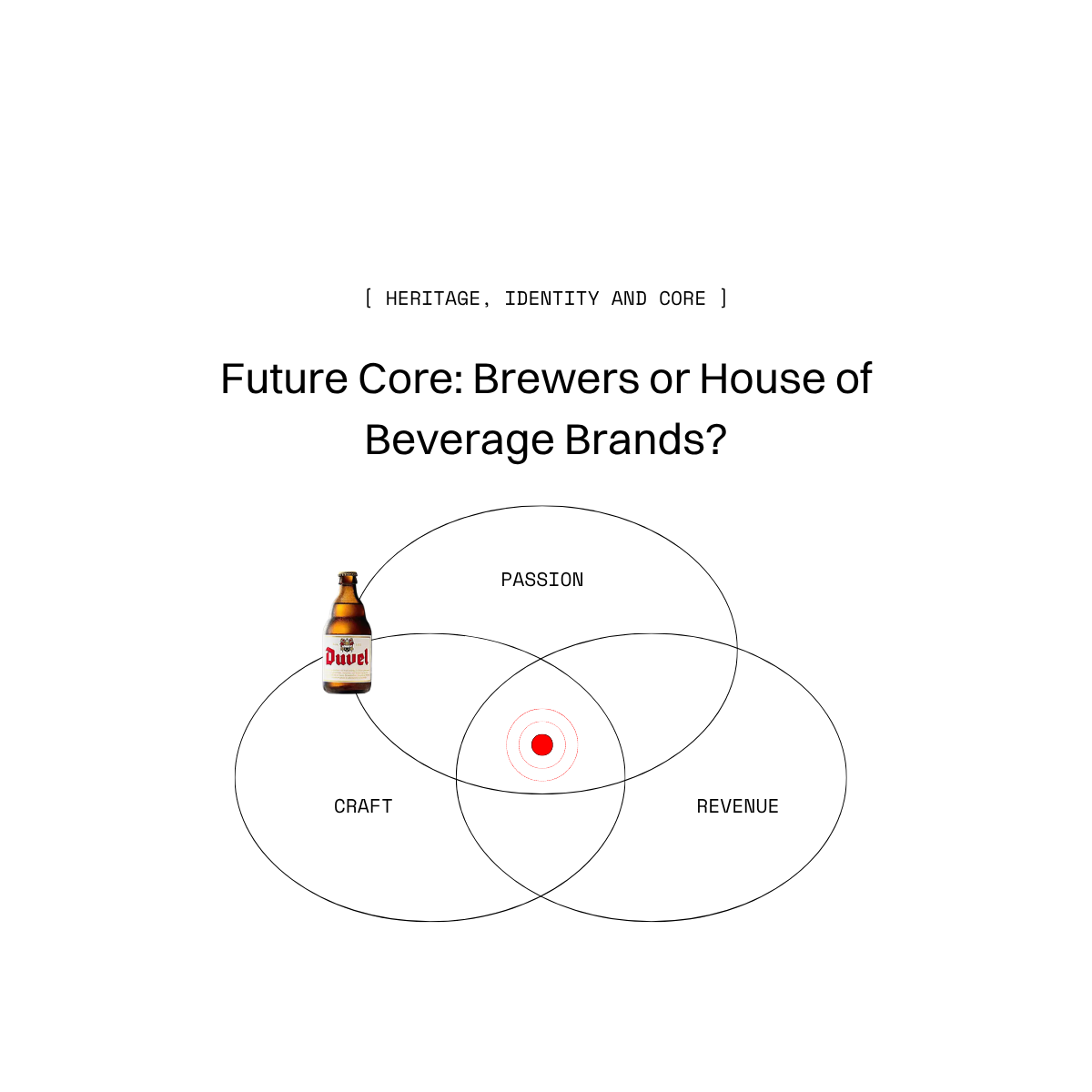
From the inside, yes, this is a brewery. From the outside, the brands they've bought, the breweries they run but didn't found, the shared infrastructure humming behind all of it, it looks less like a brewer and more like an operator of beer brands. Something closer to a small, patient private-equity house that happens to love beer.
One Insight
There's an old question in strategy that sounds basic and turns out to be the hardest in the room: what business are you actually in? The textbook answer comes from the railroads – they thought they were in railroads when they were really in transportation, and missed the car and the plane because of it. The lesson usually drawn is "define yourself broadly." That lesson is only half right, and the missing half is where most legacy businesses get hurt.
A definition does two opposite things at once. It expands and it limits, in the same breath.
→ The altitude problem
Define the core too narrowly – "we brew this kind of beer" – and you build a cage. You can't see the larger business you may have already become, and every option that isn't the product gets ruled out before anyone argues for it.
Define it too broadly – "we're in beverages," "we're in consumer goods" – and you build mush. The stories drain out of the building. Any acquisition can be justified. The moat disappears, because a business that could be anything stands for nothing.
The work isn't choosing between broad and narrow. It's finding the altitude – the words wide enough to hold your future and tight enough to still mean something. That's what makes it so hard, and why most families never do it on purpose. They inherit a sentence and stop touching it. The devil is genuinely in the detail: move the definition one notch and entirely different futures appear or vanish.
→ Why the altitude matters now
For decades, "we are brewers" sat at the right altitude. The category was healthy, so the product identity and the economic engine pointed the same way. In Belgium especially – where beer culture has been on UNESCO's list of intangible cultural heritage since 2016 – that identity isn't just positioning, it's a birthright, which makes resetting the altitude even harder.
But the ground has moved. Beer consumption in Belgium has fallen close to 20% over the last decade, down another 2.1% in 2024. Across the EU, production has slid from 367 to 345 million hectoliters since 2019 – a fifth straight year of decline. The only growing segment is non-alcoholic beer, up 25% over five years. In other words, the growth is in the part of "beer" that barely counts as beer under the old definition.
A definition fused to the product shrinks as the product shrinks. The question is whether the real capability sits somewhere else – acquiring brands, operating them well, running the infrastructure that lets a portfolio live under one roof. The Belgian market is already consolidating around exactly that kind of operator, with value shifting toward brand management rather than single-product brewing.
Bottom line & bigger picture
The family I met has, in practice, already built that second business. The acquisitions, the operations, the shared back office – that's not a brewer, it's a brand operator. The capability is real. It's simply not in the story they tell about themselves, and the gap costs them: capital flows to what they say they are, not what they've become; they're valued as a brewer in a declining category rather than an operator of a portfolio; they hire against the old identity.
This question sits upstream of every framework we've written about. Renewing inside the core or beside it, innovating on the business model versus just the product, where you land on the Legacy Pressure Map – all of it inherits the error if the core was defined at the wrong altitude. You can run a flawless inside-vs-beside decision on a definition of yourself that was already obsolete.
One Question
Is the way you describe your business a definition you still set on purpose – or one you inherited and stopped questioning?
One Opportunity
If you're the one stepping into a legacy business you didn't design, none of this stays abstract. What to keep, what to redefine, what's yours to change – including the definition of the core – is the first thing you face.
So I'm running a digital workshop session on exactly that, with Anna, external successor, transformation comms expert & CEO at Eggert Group.
→ Thursday 18 June, 4pm, limited to 10 seats and in German.
→ Let me know if you'd like to join by replying to this email.
P.S. I'm in Munich on Monday 15 June. If you're around, reply and let's grab a coffee!
Until Thursday in two weeks,
Lisa