Family Business & AI
How to make AI and innovation a priority
Why do some family businesses reinvent themselves again and again – new technologies, new business models, whole new cores – while others, with more money and better people, keep talking about it and never move?
I used to believe it's about budget or talent. But in the last 2.5 years since building Dawn Ventures, I've watched well-resourced family businesses stall and seen far smaller ones remake themselves completely. So if it isn't resources or talent, what is it?
One Insight
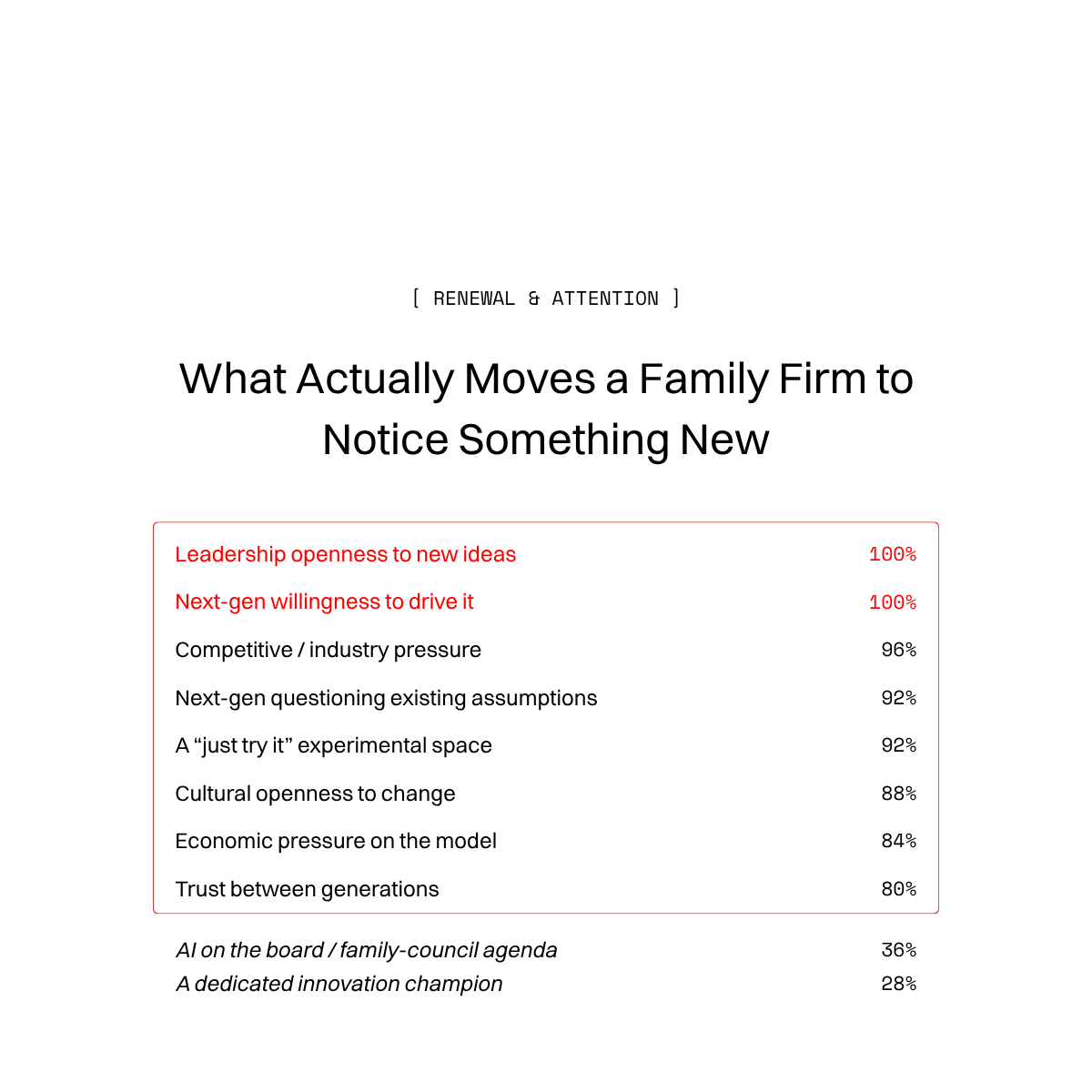
Everyone's asking how to get innovation or AI into their business. It's the wrong altitude. Two researchers, Sonia Mair and Nadine Kammerlander, just looked at the step before that. Not whether a family business adopts a new technology, but how it lands on the table at all. Before any company decides anything, someone has to notice. So they put a long list of factors in front of a panel of experts and asked which ones actually move a firm's attention toward something new.
The factors that scored highest were people. Leadership openness to new ideas. A next-generation member willing to push. Near-unanimous agreement on both. The factors that scored lowest were structures. A dedicated innovation lead – the role families create when they decide to "take innovation seriously" – landed near the bottom. So did making it a standing item on the advisory board or family council. The formal machinery we reach for when we want renewal turned out to be the weakest lever for actually triggering it.
I'd put it more bluntly than the researchers do. Committees don't notice things. People do. A structure is good at processing a decision once it's in front of you. It's almost useless at surfacing the thing nobody has decided about yet – because noticing isn't a procedure. It's someone with enough standing and enough outside perspective to say "the ground is shifting" and have the room lean in instead of glaze over. That successor isn't pushing AI because there's a committee for it. He's pushing it because he lives partly in a world that already moves that way, and he has the standing to bring what he sees back inside.
Why this is sharpest for owner-managed firms
I've worked with family businesses across the spectrum, owner-managed, family-controlled, family-influenced, and they don't behave the same way here.
In an owner-managed firm, attention and authority sit in the same head. When the owner notices, the firm moves. No board to win over, no coalition to assemble. That's the structural gift, and it's why these businesses can turn faster than anyone expects.
It's also the trap. If the owner isn't looking in the right direction, nothing reaches the table – because there's no one else with the standing to put it there. The whole firm's renewal runs through one person's peripheral vision.
Owner-managed businesses are the high-variance case: the fastest to act, and the most exposed to a single blind spot. It's part of why different firms in the same industry, with the same resources, can end up in completely different places over time – one kept looking outward, the other didn't.
The pattern underneath
A couple of issues ago I argued that innovation needs governance – decision rights, protected runway, structure. I still believe that. But I've come to see it only becomes true after the idea is on the table. Getting it there is a different job, and structure barely helps with it.
That's the real answer to why some firms keep renewing and others stall. The ones that pull it off aren't the ones with the best innovation programs. They're the ones that keep someone pointed at the edge of things and give what that person sees somewhere to go.
What we see in our work
2.5 years into building Dawn, I'd add three things the research doesn't quite say out loud.
The first is a trap I watch next-gens fall into constantly. They have the willingness the study rewards – but then they manage the new initiative instead of owning it. They assign it, resource it, sit in the review meetings, and wonder why it stalls. A new venture isn't a process to be administered. In its early life it needs someone to drive it, personally, the way a founder would. Delegation is how you run the core. It's not how you build the next thing. The two get confused, and the new thing dies of good management.
The second: the next generation's job isn't to support the existing direction. It's to question it. The most valuable thing a successor brings isn't another pair of hands on the current plan – it's the standing to ask why the plan is the plan. The ones who renew their firms are the ones who stay slightly uncomfortable to have in the room.
And the third, which I see more often than I'd expect: families install a CEO and then override them. The title is real, the authority isn't. The CEO notices something, decides to move on it, and the family quietly reverses it at the dinner table. That isn't delegation – it's the appearance of it. And it's one of the most reliable ways to make sure nothing new ever survives contact with the core. If you've handed someone the wheel, you have to let them steer, even when it's uncomfortable, even when it's not how you'd have done it.
So if you want to make AI – or any renewal – a priority in your business, the honest answer isn't to add it to an agenda or hand it to a committee. It's to drive it, or to give someone real enough authority that they can.
One Question
Across the last few years – who in your business actually noticed the things that mattered before they became urgent? And if that person left tomorrow, would anyone be looking in their place?
One Opportunity
If you're a successor and initiatives keep failing even after you delegate them – ask whether you delegated them or actually owned them. The gap between those two is where most things quietly die. If you're a manager who keeps trying to push something through and can't – ask what argument you brought, and whether it ever reached the person who could move it.
If you'd want a neutral perspective – defining where ownership sits and what an innovation process should look like in your business – let us know. This is our home turf.
Until Thursday in two weeks,
Lisa