M&A Calculations for Venturing
How to set realistic investment budgets
A few weeks ago I sat with the innovation leadership of a large family corporation and helped them work out a number: what it would actually take, in real investment, to turn the ship around?
Right now we work with a handful of families in this position. Businesses that need to change direction and know it. And from the outside, the pattern is almost always the same. They overinvest in what already exists and underinvest in what comes next. Handelsblatt calls it the "middle technology trap".
Finally, the number we landed on was far bigger than anything "sensible management" had ever set aside for the new business initiatives...
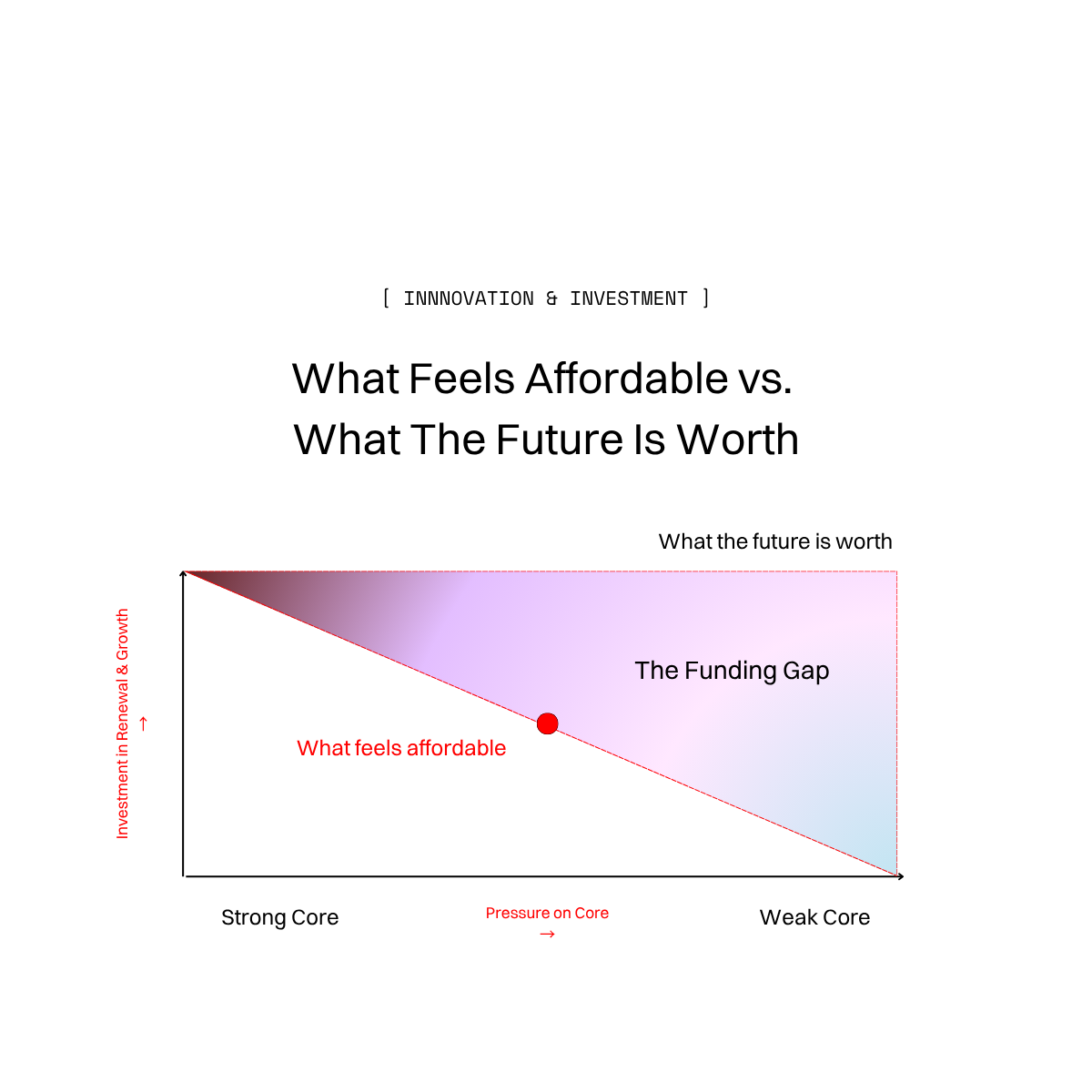
One Insight
When the core business is healthy, sizing the innovation budget off what's left over feels sensible. You've got margin to spare.
Yet, the problem shows up when the core weakens: "affordable" starts shrinking, so the money you'll commit to the replacement engine shrinks too – precisely when it needs to grow. You under-fund the future in direct proportion to how much you need it. That's the gap in the picture above, and it widens the more pressure you're under.
The research on corporate new-business building keeps landing on the same uncomfortable point. Ventures don't stall mainly because of bad ideas or weak teams. They stall because the budget was set at a level that felt safe rather than one derived from the ambition itself. Well-run, steady effort that never reaches the momentum scaling requires.
The acquisition test
Here's the reframe I now use in every one of these conversations. Stop asking "what innovation budget can we justify?" Ask "what is this new revenue stream worth, and what investment does that worth justify?"
You already know how to do this. It's the exact math you'd run on a company you were thinking of buying:
Step 1 → Set the ambition as a share of the core.
Serious firms tend to aim for roughly 10% of their core in genuinely new revenue over a decade. A measured target is closer to five percent – new businesses that don't inherit the margin structure of a core under structural pressure.
Step 2 → Value the future stream like an acquisition.
Project the revenue, apply a realistic margin, apply a market multiple for terminal value, discount it back to today at your cost of capital, then risk-adjust for the fact that only part of the portfolio will work.
What comes out the other side is your justified investment – usually far above what "sensible management" would have set aside. That number is the honest one. It's what the ambition is actually worth.
Cost framing asks what's affordable. Value framing asks what's justified. When the core is strong the two answers are close. When the core is weak they diverge violently, and only one of them builds you a second engine.
A worked example
Say your core does 100M a year. A measured ambition for genuinely new revenue is about a tenth of that – 10M a year, seven to ten years out. Now price it the way you'd price an acquisition:
→ 10M in new revenue at a 20% margin → 2M of annual EBITDA
→ at a 15x market multiple → 30M terminal value for the new business
→ risk-adjusted at a 50% success rate → 15M
→ discounted at a 7.5% cost of capital → about 11M justified investment
So the honest number behind a 10M future is roughly 11M – more than a full year of that future's revenue. In my experience, almost no family under pressure puts anything close to that on the table. They size it by what's affordable, land on a fraction of it, and then wonder why the new thing never really takes off.
Step 3 → The funnel, and the discipline to kill
Value framing tells you how much. The funnel tells you how to spend it without lighting money on fire. One scaled venture can carry the bulk of a new revenue line, so you may only need one or two survivors. But reaching one or two survivors means starting perhaps thirty and stopping most of them early, cheap while ideas are still cheap to stop, heavier as the survivors scale. The early kills are what fund the winners.
And one thing that outweighs the budget itself: who builds it. Experienced builders produce many times the new revenue of first-timers, at roughly double the success rate. A three-person innovation team run as a side project can't carry thirty parallel validations, and hiring fifteen venture builders into a legacy company takes years you don't have when the core is already eroding.
The family industrials that get through this – Hilti shifting from selling tools to leasing them as a managed service, Viessmann building a climate field beyond its heating core and later valuing it in the billions – didn't defend their way out. They funded a new engine while the old one still ran.
Bottom line
Defending a structurally pressured core buys you time. It doesn't build you a future. When the core is weak, don't size the new engine by what's left over, size it by what it's worth, protect that budget from the core, and phase it through a funnel that kills early. The instinct to wait until things stabilize is the most expensive instinct there is.
One Question
If your core keeps eroding for the next five years, what is the new revenue stream you wish you'd started funding today – and have you ever priced what it's actually worth?
One Opportunity
Want to calculate your justified investment and compare it to competitors in your niche? Let us know, we've got the data.
Until Thursday in two weeks,
Lisa