How to Build a Portfolio of 130 Ventures
The Mulliez family case study
In 1905, Louis Mulliez took over a yarn twisting factory in Roubaix. When the time came to hand it over, he did something unusual.
Instead of transferring the business to one heir (he had eleven!), he gave several of his children capital to start their own ventures and kept minority stakes.
His letters, read by later generations, explain why – he didn't want his children growing up in the "shade of the 'tree' he represented."
Five generations later, that family has founded more than 130 businesses, including Decathlon and Auchan.
One Insight
Ownership as an operating decision, not a legal one
By 1955 the siblings and in-laws were shareholders in each other's businesses – the principle the family calls tous dans tout, everyone in everything. In 1968 they formalized it into a holding, the Association Familiale Mulliez, which let members hold a portfolio of shares across the family's companies rather than a stake in one.
That single design choice does something most family structures don't. It makes launching a new business a collective upside rather than a private bet. If your cousin's venture works, you benefit. Which means nobody in the family has a structural reason to hope a new venture fails.
The second principle is the mirror image: the businesses under the holding are independent of each other. They can build synergies, but trouble in one company cannot pull down the ecosystem. Shared ownership, separated risk.
The fifteen years nothing happened
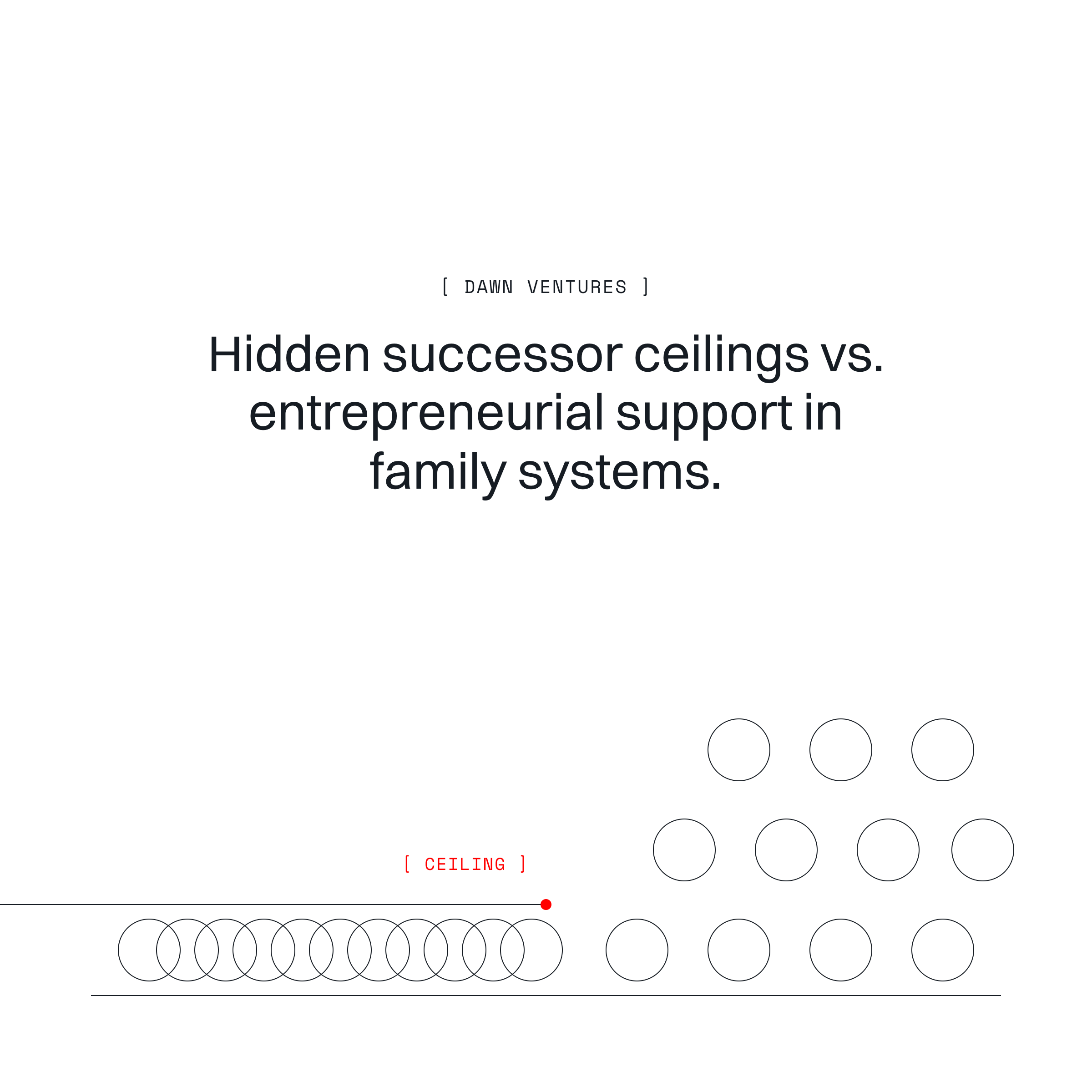
Here's the part worth paying attention to. Despite the ownership model, the governance, the capital and the track record, there was a stretch of roughly fifteen years in which no family member launched a venture inside the family system.
They were still founding companies. Just elsewhere – to avoid family oversight and the constraint of having relatives as shareholders. Antoine Mayaud, who sat on the family board, saw the danger clearly: those entrepreneurs would keep selling family shares to fund their own businesses, and eventually there would be no shared project left.
So in 2002 the family launched an investment fund, CREADEV. It worked in many respects, yet still failed at the thing it was built for. Its own family entrepreneurs stayed away. The application process was complex, and founders were unwilling to give up majority stakes.
The response was a second vehicle with simpler rules and founder-friendly terms – the Club des Entrepreneurs. More than forty family entrepreneurs came in, at a success rate above what typical funds achieve. And Mayaud is explicit that the capital was the least valuable part. What the founders wanted was access to the ecosystem: expertise, mentoring, tailored boards.
What this means for entrepreneurial families
Most families designing an incubator or a venture fund get the intent right and the terms wrong. They build something that protects the family's control, and then wonder why the entrepreneurial members of the family build outside it.
If your next generation would rather found somewhere else, that's usually not a loyalty problem. It's a terms problem. And it's diagnosable:
→ Who holds majority in a venture the family funds
→ How long the approval path is, in weeks
→ What a founder gets besides money – boards, customers, credibility
→ Whether a failed venture ends a career inside the family
There's even a research finding that should make this urgent rather than theoretical. Working with Swedish population data across 8,274 potential successors, Sieger and colleagues found that offspring who founded their own venture before any handover were roughly 83% more likely to eventually take over the family business than their own siblings who did not. Founding first and succeeding later are sequential, not alternative.
Which reframes the whole question. The point of making it easy to found inside the family isn't to keep people from leaving. It's that entrepreneurship is how the next generation becomes capable of running anything at all.
Bottom line
The Mulliez system survived a near-sale in the 1990s, when the senior generation doubted the next one and seriously considered selling the whole portfolio. What turned it was younger members proposing a third option: keep what exists and keep building.
Mayaud's warning about disengaged heirs is the sentence I'd put on the wall of most family holdings: the worst outcome in an enterprising family is a generation that only collects dividends.
You don't prevent that with a dividend policy. You prevent it by making it easy – and attractive on the terms that matter to a founder – to build something inside the family perimeter.
One Question
If someone in your family wanted to start a company next year, would they do it inside your structure or outside it?
One Opportunity
If these questions are live for you, the best place to think them through is a room with other people living the same one.
I'll be at
→ the Swiss Family Business Conference in Zurich next week
→ the Pioneers MyWay Conference in Berlin in September
→ our own NextGen Circle in Zurich in October
The latter is our own small format built for exactly these kinds of conversations: how to build inside a family structure.
Sign up and stop by if you have the chance!
Until Thursday in two weeks,
Lisa