The Family Incubator
How family businesses can renew and grow through corporate venturing
I grew up in an entrepreneurial family, and I watched part of it fail to pass anything on. One lesson from that has never left me. Entrepreneurial spirit can be inherited. A working business model can't. Every generation has to adapt, renew and innovate to keep the legacy alive.
On paper, a family business should be the ideal place to do that. Long investment horizons. Customers, know-how and trust that nobody can buy. So why is building something new still so rare in family businesses – and so accidental when it does happen?
One Insight
The blocker in family businesses is control, not appetite or capability
Family businesses get called risk-averse constantly. But that is the wrong word.
A family that owns a company across generations carries huge risk. Most of its wealth sits in one business, one industry, often one country.
But it knows that risk very well. It knows what a downturn looks like, which customers matter, when the next handover comes. The risk has a clear shape.
Innovation seems to have no shape. The forces are nameable – as a professor at HSG once put it: technology enables, customers decide, competition sets the pace, regulation sets the limit.
But what nobody can name in advance is how those four will combine for one specific business.
So that is the main difference. Risk can be measured and carried. Future uncertainty can only be leaned into. And leaning in is a technique, not a temperament.
And then there is control. Owner families do not want to give it up, and they want continuity more than they want renewal and growth. It's not necessarily rational, but understandable in the context of family businesses. The fear of losing is psychologically twice as powerful as the excitement of winning.
So the tension was never courage or capability. It was uncertainty and loss of control.
The opportunity is now
For most of the last century, launching something new meant capital before answers. You paid for tooling, a production line, inventory, a sales force. None of it could be bought in fractions. You cannot order a tenth of a machine or hire a tenth of a sales team.
So the money went out in full, and the market answered a year or two later, once it was already spent. The decision had to be made once, in advance, and it could not be taken back. That is why judgment mattered so much, and why caution was rational.
That order is now reversed. You can answer the critical questions before the money follows: Is the problem real? Who pays? Does distribution work? Does it scale? AI made answering them faster and cheaper. Building is cheaper too – a first version and a first route to market now take a few people a few weeks.
You still do not know the answer in advance. But you find out sooner, and being wrong costs less. Uncertainty no longer has to be swallowed whole. It can be taken apart and paid for in pieces.
Three things follow:
Opportunity: a family can now afford several attempts where it could once afford one.
Exposure: it is cheaper for everyone else too. New competitors appear faster. The model that pays the bills today gets attacked sooner.
Moat: the real challenge isn't bringing an innovation to market, it's building a sustainable and scalable business model – which requires long-term commitment and patient capital. Exactly what families can bring to the table.
Three vehicles for structured innovation
Venture building → Build a new business, or rebuild the one you have. You start with what the family already owns: entrepreneurial energy, shared values, customer relationships built over decades. Those cannot be bought. The catch is that the venture leans on the core, so it rises and falls with it.
Venture clienting → Buy from a startup instead of investing in it. Pilot what someone else has built. The gain lands straight in the operating business – a faster process, a lower cost – and the most you can lose is the price of the pilot. It also shows you quickly whether your organization can absorb anything new at all. Most families skip it because it looks like procurement.
Venture capital → Invest through funds or directly. No operations, no close strategic fit required. What you buy is a view of what is being built outside your industry.
Start with a mandate
Most families overinvest in today and underinvest in tomorrow.
Families that try to fix this copy corporate governance – stage gates, budget cycles, business plans. That imports the discipline of a corporate and none of the advantages of being an owner: patient capital, decisions made in one room, no quarterly audience.
And the unit usually sits inside the operating business, managed like a business. A venture portfolio is not a business. It is an investment. You do not judge it one position at a time, and the result comes from the portfolio rather than from any single venture. Progress is a question answered, not a milestone hit.
But that only works with enough positions in your portfolio. Three ideas are not a portfolio – with three, you have to be lucky. With a dozen, you only have to be right once. This is why the collapse in the cost of finding out matters so much: the money that once funded one full commitment now funds a dozen tested ones.
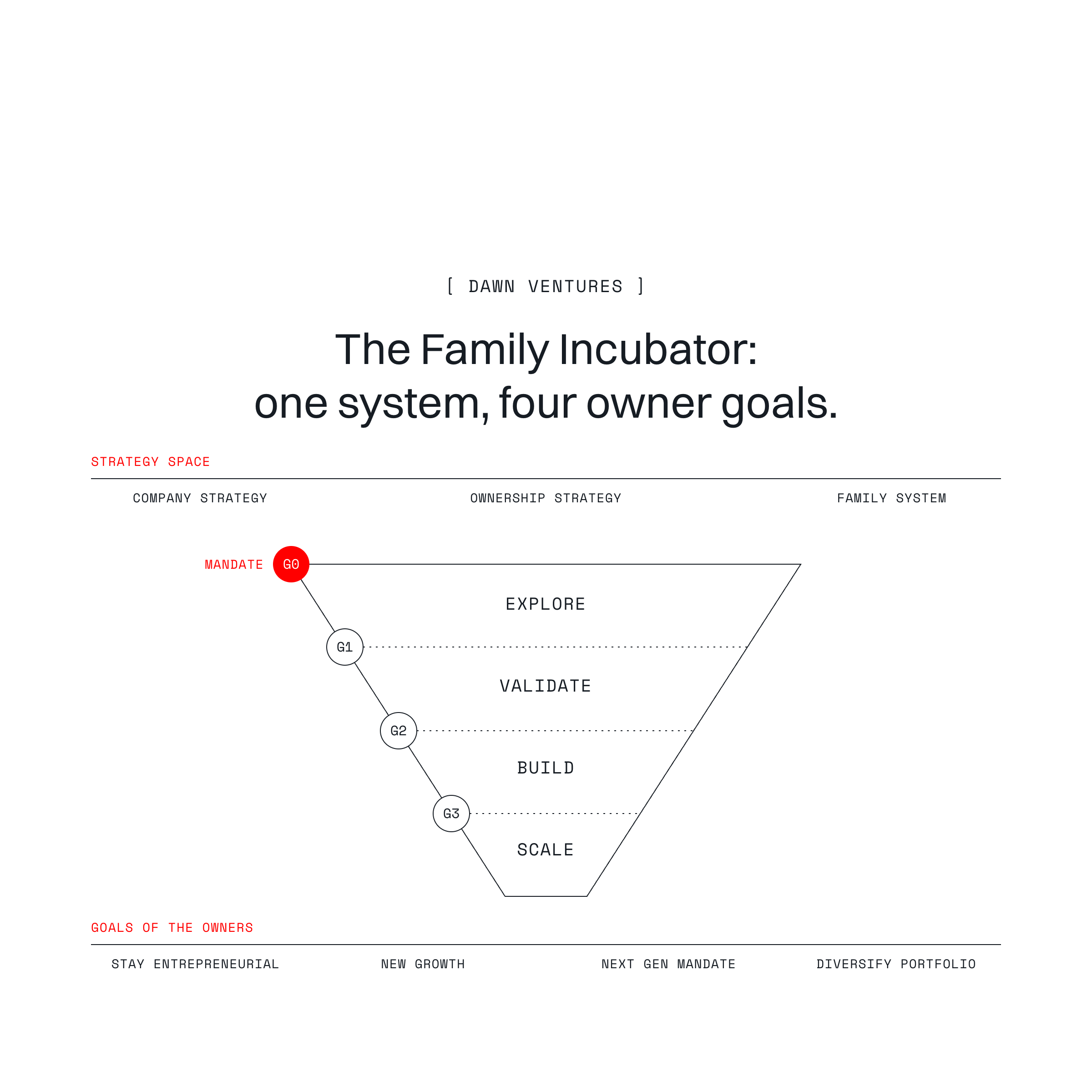
So it starts earlier than most families think. Not with an idea. Not with a process. It starts with the owners: what innovation is for here, what it should do, how much they will put in over how long. That is the mandate.
And a mandate – the goals, the investment, the fail conditions – does not remove uncertainty. It does not give you control over the outcome. It gives you control over what is at stake and what you do about it.
One Question
Is your family business managing innovation like an investor or like an operator?
One Opportunity
For everyone who keeps telling me I should write in German, I did! A short piece on "Familien als Inkubator für neue Geschäftsmodelle" goes up on FUTUN Werk:Log on September 9.
It comes out of work we have been doing with family advisors. When a family asks what comes next, the answer is usually governance, structure and succession. It is rarely building something new – not because advisors avoid it, but because it is not yet part of what most of them offer. It requires different expertise.
So, two questions rather than a conclusion. If you advise families: what would it take to make building part of your offer? And if you are a family already looking at one of the three vehicles, I am glad to share what we have seen across our clients – what worked, and what it cost.
Until Thursday in two weeks,
Lisa