When to Kill a Venture
Why every phase needs a stop
Our new website is live at dawnventures.ch. It finally shows how we run a new business building project, including clear steps, phases and a portfolio perspective. And today I want to share a case that explains why we run things that way.
EVVA, a Viennese family business, has made locking cylinders for more than 100 years.
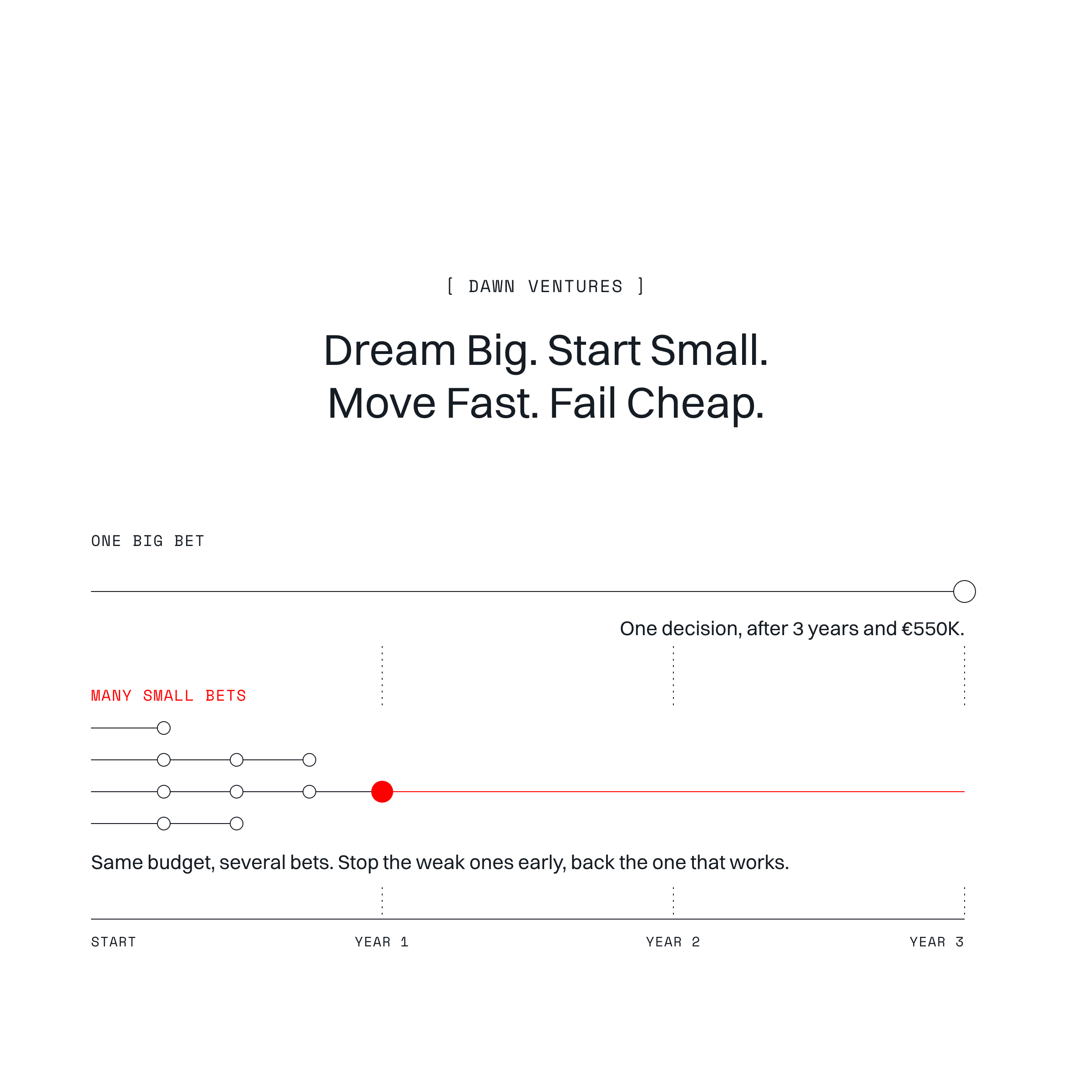
Its first attempt at a new business model ran for three years, cost €550,000 and ended with two paying customers.
One Insight
To me, the case shows two things venture building needs. The first is clear gates, so a weak idea is stopped early. The second is volume. Building new businesses is an investment in the future, and you do not bet all of it on one horse.
In the end, it was EVVA's successor, Konstantin, who said it: this does not work. Most family businesses read a story like this as a warning against trying. I read it the other way. The €550,000 was not the expensive part. The three years were.
The failure was not the money
The first venture wanted to digitize how tenants reorder keys. A real problem, close to the core, with good margins. It got its own company, its own office and a team.
What it never got was a written answer to one question: what would have to be true for this to work? Would a tenant pay online? Would they accept a house key in the mailbox? Nobody wrote it down, so nobody could test it. The business case was reworked three times. The product pivoted four or five times. The decision to stop came at the very end, after all the money was spent.
Any new venture can fail. That part is affordable. What is not affordable is finding out in year three what you could have learned in month three.
Why stopping is harder in a family business
Konstantin was open about why it took so long. The people deciding were his parents and the management board. Nobody in that room had ever stopped a project. And this one was driven by a member of the owner family.
There was a second weight. Many people inside had never understood why the venture needed its own company and office. Stopping it meant proving every doubter right.
So the successor had to stop his own project, in front of his parents, knowing the core would say "we told you so." He described it as having to rationalize yourself away. Afterwards, he said, it was a relief.
Asked what he would do differently, he said he would not be the link between the venture and the family again. The family should back the venture as its ambassador. Someone else, with a clear mandate, should run it.
What changed the second time
The second venture, EVVA OpenOne, a connected home security bundle, ran differently. First, the team decided where to look: integrated security, close to what EVVA already knows. Only then did it search for problems to solve. Each phase had a small budget and a clear result. After every phase, everyone sat down and decided again.
One test shows why. The team assumed about 75% of buyers would take the full bundle. When they asked more than 100 people through surveys and door hangers, 33% did. That number changed the offer, the pricing and the business case, in weeks rather than years.
The second venture reached the same point as the first, the moment to decide whether it works, after one year and €150,000.
What the second venture does not prove yet
It is fair to be skeptical here. The second venture is still in validation, with the next decision two months away. The 33% also came from surveys, not from real sales. And the team was faster partly because it had already failed once.
So the case does not prove that the method produces winners. It proves something smaller and more useful: you can reach the decision much earlier and much cheaper.
Why one venture is not enough
Konstantin named the next problem himself. With one project in the pipeline, stopping it leaves you with none. EVVA built three business models in 100 years. The next ones will have to come faster.
So EVVA no longer sets a revenue target for innovation. It sets a result it wants to earn over a number of years and works backwards: how many projects fail, what each phase costs, and how many projects it therefore has to start. The question is not whether one venture works. It is whether the pipeline is big enough for some to work.
Four things to set before the next budget round:
→ Write the kill criteria before the first franc is spent.
What would make you stop?
→ Budget by phase, not by project.
The risk budget grows with evidence, not with hope.
→ Decide who stops it.
Not only the person who started it, and not only the family.
→ Keep more than one project in the pipeline.
A stop should not mean starting from zero.
Bottom line: A failed venture is affordable. A venture nobody is allowed to stop is not.
One Question
If your most promising project failed its next test, who would stop it?
One Opportunity
Explore our new website. It brings everything together in one place: our case studies, how we run a build from the first phase to the last, past issues of The 1-1-1, and what is coming up in our community.
%2520(2).png)
Until Thursday in two weeks,
Lisa