Innovation and the Board
What a board should decide – and what it shouldn't
I spoke at the SIX family business conference last month. One of the things I said from the stage: a board that meets three or four times a year is not the right body to govern innovation.
The objection came back straight away, and it was fair: innovation needs commitment from the top. Everyone at these events agrees on that.
Both are true. A board cannot decide at the speed a new business moves. And a new business goes nowhere without the owners behind it.
So what is a board actually supposed to do? This is my answer.
One Insight
A board governs by numbers. Plan, variance, business case. That works on an operating business, because an operating business produces numbers. A new business has none yet – and that is not weak preparation, it is what makes it new.
So when an innovation proposal reaches the board, the reasonable response is to ask for more evidence and come back next time. Next time is three months away...
And while waiting looks like prudence, it works like a no.
Researchers call this financial control versus strategic control (Baysinger and Hoskisson, 1990). Financial control rewards what can be checked against a plan. Innovation has no plan to check.
From 10 years of innovation and venture building experience, this is my opinion: The board's job is not to decide the projects. It is to set and adjust the rules once a year, then stay out of the way until the evidence comes back.
Here are 5 steps to take as a pioneering board in a family business.
1. Split last year's decisions in two.
Which innovation decisions had a business case, and which could never have had one? If the second column is empty, you are steering business development, not innovation and venturing. That is fine – it just means the rest of this doesn't apply yet.
2. Set the budget before the projects.
The board should decide the budget once a year, not for each project. Size it by what the new revenue is worth: project it, apply the margin and a market multiple, risk-adjust, discount back. Newsletter No. 55 came with the full calculation – a CHF 100M core aiming at CHF 10M in new revenue justifies an innovation budget of around CHF 11M.
3. Write down a threshold.
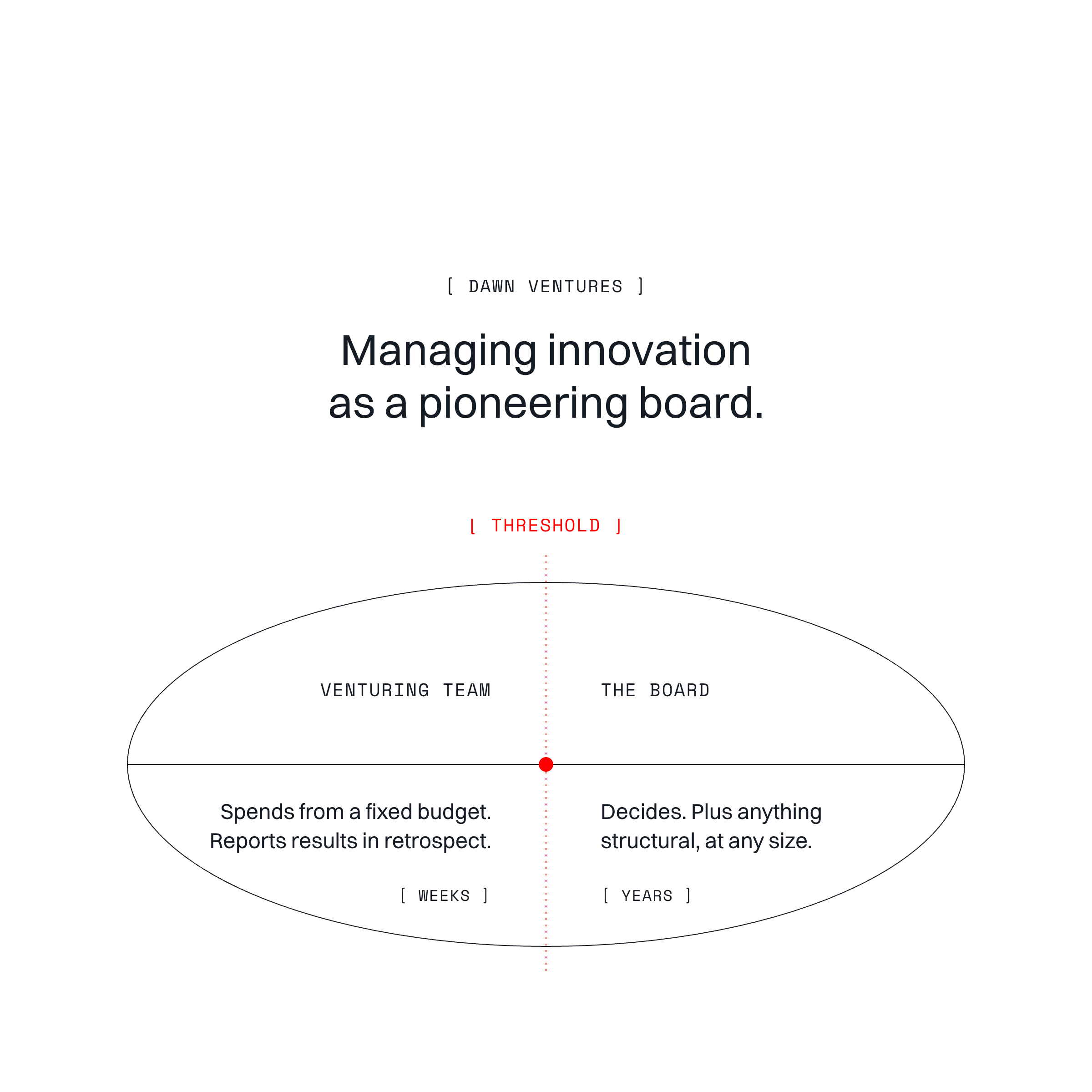
One fixed number. Below it, the venturing team spends and reports in retrospect. Above it – or anything structural: a new legal entity, a venture partner – the board decides. It works like the spending-approval line you already have for OPEX and CAPEX, set for innovation. Pick a number you would be comfortable seeing spent badly three times. There is a learning curve. But not investing is not an option either.
4. Replace approval with gates.
At a gate the board does not approve a plan. It decides whether the evidence was good enough to continue. Three legitimate answers: continue, stop, change. Name the evidence before the work starts, put money behind each gate, and schedule the gates around the venture rather than around the board.
5. Choose where these initiatives live now, not later.
Core, subsidiary or sandbox? Ventures rarely die of the wrong structure. They die because nobody chose one. Ventures in the core have a hard time adopting new systems and keeping up with startup speed. Ventures outside the core carry more pressure to stand on their own. The decision depends on the specific initiatives and whether a venture can actually benefit from the core.
3 things that look like a fix but don't move innovation forward:
→ More board meetings.
Results in the same control mode, just twice as often.
→ Setting up an innovation committee.
It changes who is involved, not who decides. In whataventure's third annual survey of corporate venture units in the DACH region, 97% say top management is involved in some capacity – and over three years the share naming top-management commitment as a problem still rose from 28% to 36% to 42% (large corporates, not family businesses, and a small sample, so take the direction rather than the number). Nobody is short of a sponsor at a steering meeting. What is short is the authority to decide, and the willingness to keep deciding when the strategy moves. A committee adds sponsors.
→ Asking the board to approve a business plan.
For a venture with no customers yet, there is no business plan to approve – that is what makes it a venture. There is still plenty the board should approve: the overall venturing revenue goal, a time horizon the team can realistically reach it in, the budget that buys the attempt, and the process that decides when to stop. That is the system, and approving the system once is the board's job. What cannot be done is approving each business case.
Bottom line: A board can only judge what it can measure, and a new business has nothing to measure yet. Either someone can spend without asking, or you have decided not to build anything.
One Question
Who in your company can spend budget on a new business idea without asking the board?
One Opportunity
Steps 1 and 3 you can do yourselves this quarter. They cost nothing but an internal conversation.
If you would rather not do it alone, the guardrails are the part we help with – the envelope, the threshold, the gates – so the board can back a venture without having to decide it every time. Reply with one line: "We need guardrails for innovation." and tell me which of the five steps you already have in place. I'll come back with what I would look at first.
P.S. I'll be at the Pioneers MyWay Conference in Berlin on 22 and 23 September. See you there?
Until Thursday in two weeks,
Lisa